
Day 35: Holy Crap
2026-03-13
Hello!
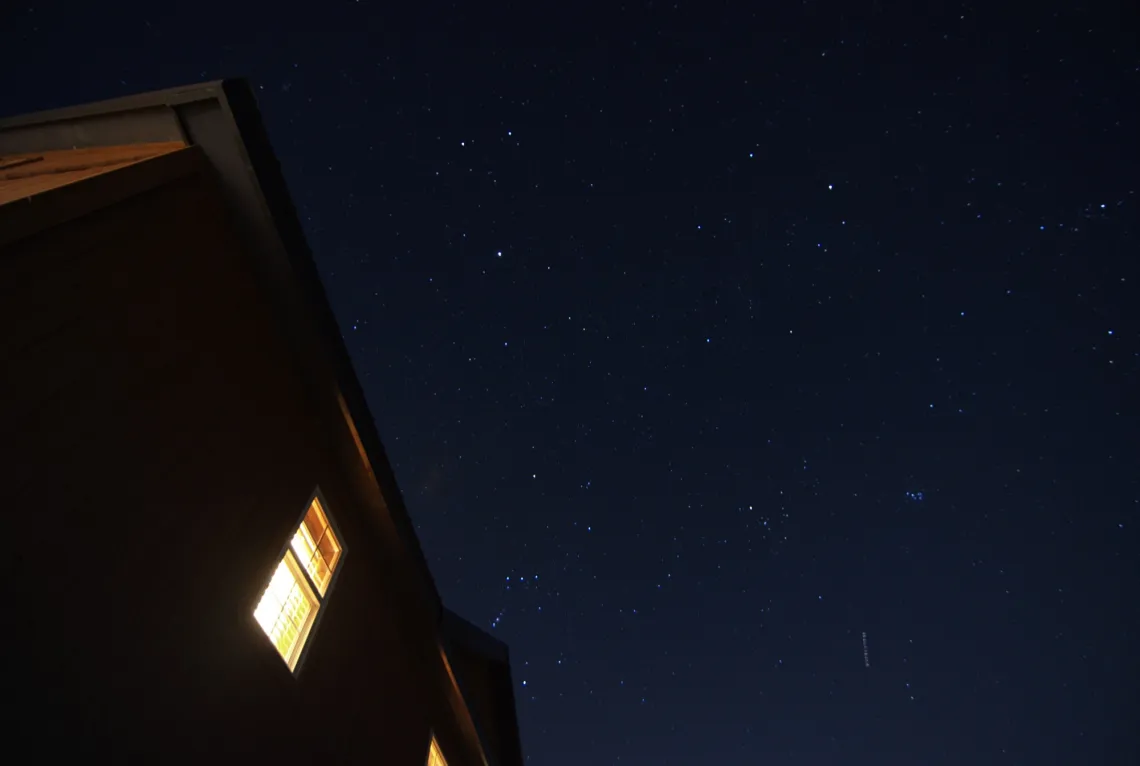
This photo is a special one for me. I live in an area without too much light pollution, so I can see some stars. But there's enough light pollution to prevent me from seeing more stars than I can count.
I could never hope to recreate those images of the Milky Way galaxy, but for years, I've been aching to camp out in a remote area and photograph the stars.
This March, I had the chance to get close to that goal. Searching for the stars became a feasible mission that I kept to myself, not wanting to jinx it.
I still jinxed it. I left my camera tripod at home, so I don't have any way of stabilizing the image. But starlight is so dim and so small that you can't just take a snapshot of it like any other quick street scene. You must keep the sensor open for a longer time — on the magnitude of whole seconds, rather than slivers of a second.
There are three ways to allow the camera sensor to detect more light. You could open the sensor for a longer time, exposing it to light over a duration of seconds. That's what I did to this image. But at such a long shutter speed, a handheld image would look blurry from the natural heartbeat coursing through my hands, causing shake. The stars would be offset by a small amount, and dots of stars become streaks.
So I tried resting the camera on the ground, or on a fence post. It worked, but I kept looking for different angles and better ideas. So I laid on the ground and rested the camera on my chest, holding my breath for those ten seconds. Or I rested it on my chin and used it to angle the camera just right.
Sounds crazy, because... it is. But the results are worth it.
You could also increase the aperture (create a bigger hole for light rays to be directed onto the sensor) or, as a last resort in this case, program the sensor to be more sensitive to light (increase its ISO). Modifying ISO for astrophotography isn't preferred because it could also introduce digital noise to an image, bringing in specks of fake light that weren't there. When the pin-sized points of stars are already so small, digital noise can make an image look especially messy.
These three parts — shutter speed, aperture, and digital ISO — make up the exposure triangle. Search up "photography basics" and you get videos on the exposure triangle. Each side of the triangle you modify has its advantages and compromises; dealing with those consequences and maximizing the advantages makes up the basics of photography as an art.
Thank you for visiting this blog! Special thanks to the newsletter subscribers; you get this photo a week before the internet does :-).
Cheers,
David
Technical info, for nerds
- Camera: Nikon D7200
- Lens: Tokina AT-X Pro 11-16mm f/2.8 DX II
- Focal length: 11mm
- Exposure: 10 sec shutter speed, f/2.8 aperture, ISO 640
- Edited with: Photopea.com