
Day 44: Dine In
2026-03-22
Hello!
First, a technical note: I've added text to the home page. Took me too long to figure out how.
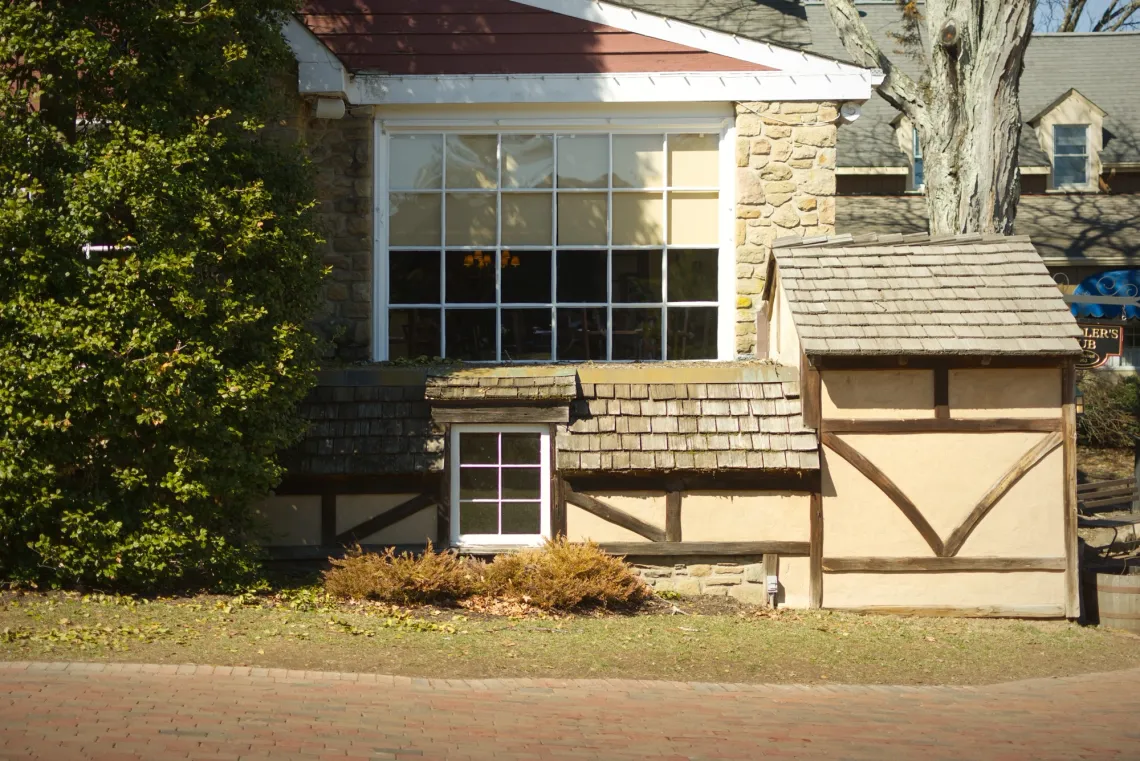
There's something pleasing about these kinds of shots. When you find perfectly straight vertical or horizontal lines outside of a controlled studio, it looks organized. In this case, you see one side of a building head-on, no imperfect angles.
I don't know the best term for this kind of image. Symmetry doesn't quite describe it — the image is weighted to the left with the tall, thick tree, and the brick road below doesn't match anything up top. My best guess is something related to "orthographic projection", as the building is presented head-on.
It looks like a plausible background that has just enough depth to stay interesting while being simple. Passersby would walk by left or right, without any reason to go forward or back.
Trying to find an accurate way to describe this scene and how it makes me feel has been an unsuccessful challenge. While trying to find the right term, I've stumbled down various rabbit holes of interesting landscape design and advanced photography composition.
If you can decipher the puzzle that I've laid out today, please get in touch! I'd love to add a correction at the top of tomorrow's article with the actual search term of this type of photography.
And while I have you thinking about composition and the angle of a shot, I'd like to note another aspect of this image that's pleasing to me. There are certain focal lengths that achieve certain feels and moods.
The focal length of a typical smartphone camera (for example, the iPhone's 1x camera — showing a field of view anywhere between 80° and 84° depending on the model) is too wide. It instantly gets associated with the look of smartphone photos, and because everyone uses their smartphone, the look feels overused.
The focal length used by professional wildlife photographers (showing a field of view anywhere between 3° and 8°) is really zoomed in! You can get detailed shots of an animal from a safe distance, but it's not realistic to what you could see with your human eye. Wildlife photographers might as well be carrying around a telescope with that super-narrow field of view.
For whatever reason, my favorite focal length by far is the one used today. It's natural to how you see things, minus some of your peripheral vision.
I have some technical numbers to back up my preference. To any photographers and mathematicians in the room who know where this is headed: I'm going to be simplifying a discussion of equivalency.
My camera has a rectangle sensor, and its diagonal works out to 28mm. If you look at the "technical info, for nerds" section below, you'll notice that this shot was achieved with a focal length of 35mm (or a field of view of 44°). Almost a perfect match: not too wide, a bit narrow. If my lens was at 28mm, it would be even closer to a natural field of view (of 53°), but cutting out some of that distracting peripheral vision is actually useful.
I mention this natural field of view because it's subjective. Because you have two eyes rather than one sensor, there's no simple number for the field of view you see. It's complicated. But the huge oversimplification is that this natural field of view corresponds to what you see.
The natural field of view is built into a camera called the Leica Q3 43. Although it has a different sensor size, the lens attached to that camera achieves that natural 53° field of view. So you can take a shot, and capture everything that you see. Sounds great!
Oh right, that camera costs $7,950 USD. It's the Porsche of cameras. You know what, my camera's fine.
Thank you for visiting this blog! Reply by email, subscribe via RSS, or join the 1Day1Photo newsletter, where you can get this photo a week before the internet does :-).
Cheers,
David
Technical info, for nerds
- Camera: Nikon D7200
- Lens: Nikon AF-S DX Nikkor 35mm F1.8G
- Focal length: 35mm
- Exposure: 1/1600 sec shutter speed, f/1.8 aperture, ISO 100
- Edited with: Affinity