
Day 86: Dirt Spots
2026-05-03
Hello! First, a technical note: I bought a third domain name, and I already regret it. Come check out dingusberry.com and tell me what I should do with it.
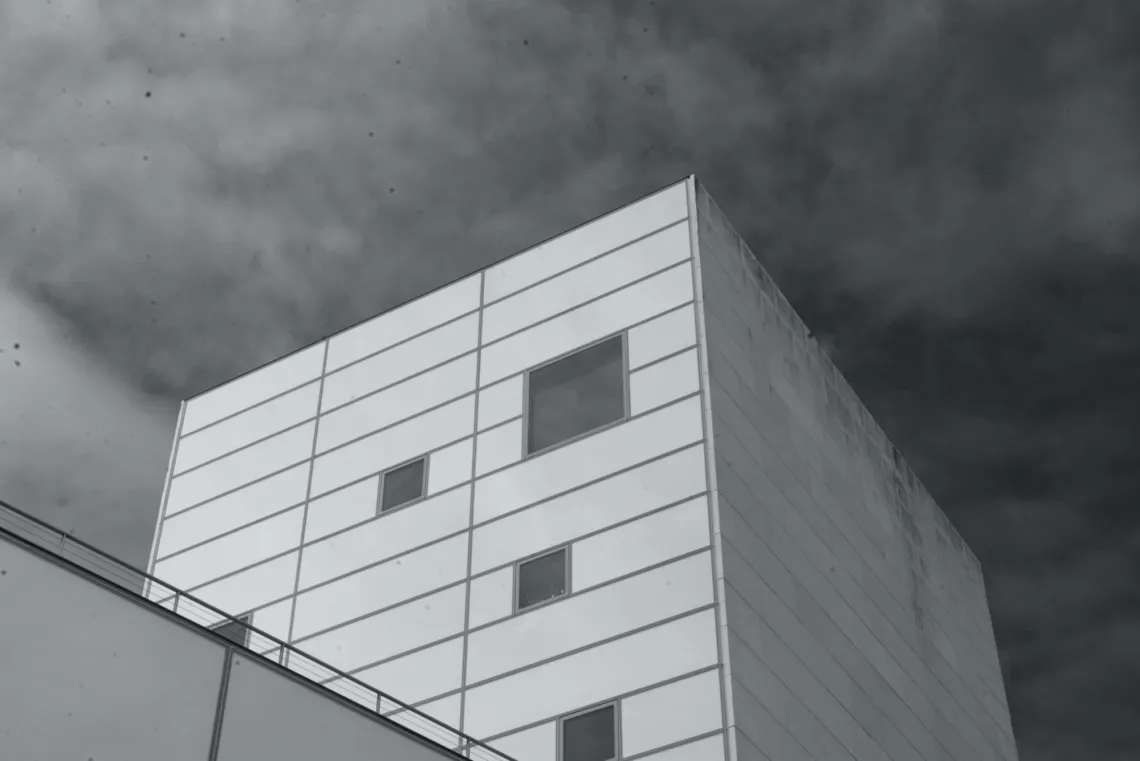
When you use a shallow depth-of-field (something like f/2.8) you are able to separate the background from your subject, with a decent falloff and blurriness that can help eliminate busy distractions.
But if you want everything to remain in focus — especially for architecture photography — a larger depth-of-field (something like f/8) is required. Because of physics, less light comes to the camera sensor as a trade-off.
This photo is in f/16 — everything should be in sharp focus! ... Including the dirt spots that are stuck to my camera sensor or lens. I don't know how to get them off.
Now's a reasonable time for me to disclose the state of my equipment and what's been going on. As always, the technical info, for nerds is below.
I purchased my camera from eBay for less than a third of the original retail price. I bought it before the AI-driven economic crisis of current-day, and the used market for my camera demands higher prices than what I got it for, despite the camera being positively old today ($1200 new body-only, bought used for $450 in a bundle with two lenses, now going $500 body-only due to crisis). To be fair, I got lucky in the used market. The camera also came with two lenses and I was the only one who put in a serious auction bid. Score.
The lens used for this photo was bought separately, and also purchased from a used market for about a third of the original retail price. I bought it at the low point ($200 new, bought used for $70, now going for over $100).
Buying used is worth it. Unless you have a job that pays well enough to demand new gear, used gear allows you to experiment and tinker without having to baby your camera — it already has scuffs on it, and I think it adds character.
But over time, my camera has accumulated two issues. One is the dirt spots seen above. These small bits of grime are extremely distracting, and I'm sure a quick cleaning solution combined with a how-to article could fix it. When I get around to doing a deep clean, I'll post my results on this website.
A more pressing issue is that my display is struggling bad. Ever since the Lunar New Year festival of late February this year, I've noticed a crack on the lower-right of my display. I don't know the inner electronics of this camera, but I can only assume that power to the display has been damaged, as the pixels are not able to show their red or blue.
I've got a screen with basically one-third the resolution now, only showing green. It looks straight out of The Matrix.
Repairing it would be too expensive, and I don't need to use the screen for anything important. I can take images just fine (at wide-open apertures due to dirt) and so long as I nail my focus, I don't need to check them again on my broken screen.
Besides, the green effect looks novel and interesting. I just need to remind myself never to show my camera to anyone in the professional world, whether that be a client or another photographer. Hell, even my teacher volunteered to take a picture of a group of friends with my camera before handing it back and muttering "I think it's broken".
Finally, the internet TV. A nostalgic way to find small websites without an algorithm, it's also a cool way to see sites filtered through an old TV display. What does my site look like?
Thank you for visiting this blog! Reply by email, subscribe via RSS, or join the 1Day1Photo newsletter, where you can get this photo a week before the internet does :-).
Cheers,
David
Technical info, for nerds
- Camera: Nikon D7200
- Lens: Nikon AF-S DX Nikkor 35mm F1.8G
- Focal length: 35mm
- Exposure: 1/100 sec shutter speed, f/16 aperture, ISO 100
- Edited with: Affinity